In heavy industrial lifting applications, a 100-ton gantry crane represents a significant capital investment and a critical component of material handling operations. While load capacity often receives the most attention during crane selection, lifting height plays an equally crucial – if not more complex – role in determining the crane’s structural design, safety performance, cost, and long-term reliability.
Lifting height directly affects the overall geometry, stress distribution, stability, wind resistance, hoisting system configuration, and foundation requirements of a gantry crane. For a 100-ton capacity crane, even a small increase in lifting height can lead to substantial changes in steel structure design and engineering calculations.
This article provides an in-depth analysis of how lifting height influences the structural design of a 100 ton gantry crane, helping project planners, engineers, and procurement teams make informed decisions.
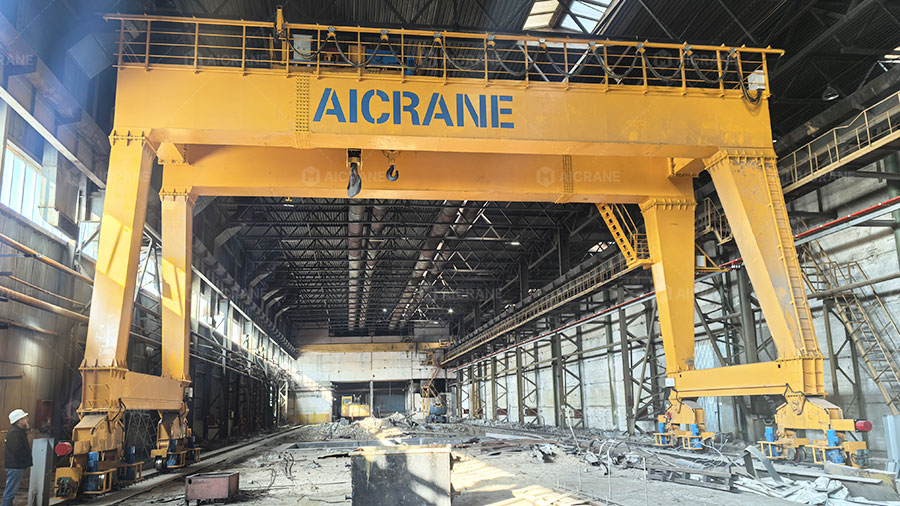
1. Understanding Lifting Height in Gantry Crane Design
1.1 Definition of Lifting Height
Lifting height refers to the vertical distance from the ground (or rail top) to the highest hook position. It is not the same as crane height, which includes additional structural elements such as girders, trolley mechanisms, and safety clearances.
For a 100-ton gantry crane, lifting heights commonly range from:
-
10–15 meters for workshops and yards
-
20–30 meters for precast concrete or steel structure handling
-
30+ meters for shipyards, hydropower projects, or specialized industrial facilities
1.2 Why Lifting Height Is a Critical Design Parameter
As lifting height increases, the crane structure must:
-
Support higher bending moments
-
Resist greater lateral forces
-
Maintain load stability and anti-sway performance
-
Prevent buckling of legs and columns
-
Comply with stricter deflection and fatigue limits
2. Impact on Main Girder Structural Design
2.1 Increased Bending Moments
Higher lifting height typically requires:
-
Deeper hoisting systems
-
Larger trolley assemblies
-
Longer wire ropes and reeving systems
These factors increase the self-weight of the trolley and hoist, which adds to the load acting on the main girders. For a 100-ton double girder gantry crane, this leads to:
-
Higher vertical bending moments
-
Increased girder depth
-
Thicker flange plates and web plates
As lifting height increases, engineers often shift from standard box girder designs to reinforced or multi-cell box girders to maintain structural rigidity.
2.2 Deflection Control Requirements
Crane standards (such as FEM, EN, ISO, or GB) impose strict limits on girder deflection. Taller lifting heights amplify:
-
Dynamic effects during acceleration and braking
-
Load sway-induced stress variations
To control deflection:
-
Girder stiffness must increase
-
Steel grade selection becomes more critical
-
Additional internal stiffeners may be required
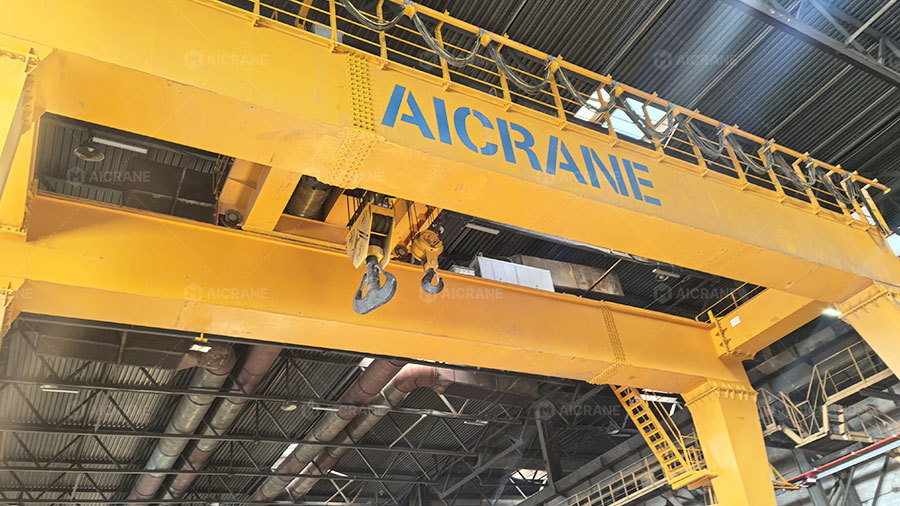
3. Influence on Gantry Leg Design and Stability
3.1 Slenderness Ratio of Crane Legs
As lifting height increases, the overall height of gantry legs also increases. This directly affects the slenderness ratio, making the legs more susceptible to:
-
Buckling
-
Lateral deformation
-
Fatigue under cyclic loads
For a 100-ton gantry crane with high lifting height:
-
Legs require larger cross-sections
-
Box-type or double-column leg structures are often preferred
-
Additional horizontal bracing may be introduced
3.2 Load Transfer and Stress Distribution
Higher lifting heights increase:
-
Vertical load transfer distances
-
Horizontal forces at the base of the legs
This demands:
-
Reinforced leg-to-girder connections
-
Thicker base plates
-
Stronger anchoring or rail systems
4. Wind Load and Environmental Effects
4.1 Wind Load Amplification
Wind pressure increases exponentially with height. A 100-ton gantry crane with a 30-meter lifting height experiences:
-
Significantly higher wind moments
-
Greater overturning risk
-
Increased lateral deflection
Structural designers must:
-
Increase leg stiffness
-
Optimize crane geometry to reduce wind exposure
-
Incorporate wind-resistant design features
4.2 Outdoor vs Indoor Applications
Most high-lifting-height gantry cranes operate outdoors. Compared to indoor gantry cranes, they must withstand:
-
Strong winds
-
Temperature variations
-
Corrosion and fatigue over time
This further influences:
-
Steel material selection
-
Protective coatings
-
Structural redundancy levels
5. Hoisting System and Reeving Configuration
5.1 Longer Wire Ropes and Heavier Hoists
Higher lifting height requires:
-
Longer wire ropes
-
Larger rope drums
-
More powerful hoist motors
These additions increase:
-
Trolley weight
-
Dynamic loads acting on the structure
-
Stress on girder rails and end carriages
For a 100-ton crane, designers often use:
-
Multi-layer drum hoists
-
Multi-fall reeving systems (e.g., 8/10/12 falls)
Each configuration impacts structural load calculations.
5.2 Dynamic Load Amplification
With increased lifting height:
-
Rope elasticity increases
-
Load acceleration effects are magnified
-
Dynamic load factors rise
This requires:
-
Higher safety coefficients
-
Enhanced fatigue design
-
Integration of anti-sway and intelligent control systems
6. Influence on Foundation and Rail System Design
6.1 Higher Base Reactions
A taller crane structure generates:
-
Larger vertical reactions at wheel loads
-
Greater horizontal forces on rails
For a 100-ton gantry crane, lifting height significantly affects:
-
Rail beam sizing
-
Foundation depth
-
Ground bearing capacity requirements
6.2 Rail Gauge and Stability Considerations
To counter increased overturning moments:
-
Wider rail gauges may be required
-
Heavier rail sections are often selected
-
Rail alignment tolerances become stricter
7. Fatigue Life and Service Classification
7.1 Increased Fatigue Stress Range
Higher lifting heights lead to:
-
More pronounced stress cycles
-
Increased vibration during lifting and lowering
-
Greater fatigue demands on welded joints
For 100-ton gantry cranes in heavy-duty applications (A6–A8 duty classes):
-
Fatigue design becomes a governing factor
-
Weld details and joint geometry are critical
-
Structural redundancy improves safety margins
7.2 Long-Term Reliability Considerations
Designers must balance:
-
Initial steel weight
-
Fatigue resistance
-
Maintenance accessibility
A higher lifting height often results in:
-
Increased steel consumption
-
Higher fabrication and installation costs
-
Longer service life when properly designed
8. Cost Implications of Increased Lifting Height
8.1 Direct Structural Cost Increase
For a 100-ton gantry crane:
-
Each additional meter of lifting height can significantly increase steel usage
-
High-strength steel may be required
-
Fabrication complexity rises
8.2 Indirect Engineering and Installation Costs
Higher lifting height also impacts:
-
Transportation logistics
-
Erection complexity
-
Installation time and manpower
These indirect factors must be considered during project budgeting.
9. Optimization Strategies in Structural Design
To manage the influence of lifting height effectively, gantry crane manufacturers often adopt:
-
Finite Element Analysis (FEA) for stress optimization
-
Modular structural design concepts
-
High-strength, low-alloy steel materials
-
Intelligent control systems to reduce dynamic effects
Proper optimization ensures:
-
Structural safety
-
Cost efficiency
-
Long-term operational reliability
Conclusion
The lifting height of a 100-ton gantry crane is far more than a simple dimensional parameter – it is a core structural design driver. As lifting height increases, it influences every major aspect of the crane’s structure, including main girders, legs, hoisting systems, wind resistance, foundations, fatigue life, and overall cost.
For project owners and engineers, understanding this relationship is essential when specifying crane requirements. Selecting an appropriate lifting height – aligned with actual operational needs – helps achieve the optimal balance between performance, safety, and investment efficiency.
In high-capacity gantry crane projects, lifting height should always be evaluated alongside load capacity, span, duty class, and operating environment to ensure a robust and future-proof crane solution.